
Every claim
has a document
behind it.
Forty-six years of training. Zero recorded training accidents. Instructors who still fly. ICAO-aligned curriculum. Every one of these claims is backed by a document — Approved Training Organization Certificate No. 84-11, ICAO Annex 1 standards, a signed Skyway Airlines cadet pipeline MOU, and four decades of alumni flying for airlines worldwide. This page is where the documents live.
Flight training is one of the few industries where marketing language and regulatory reality rarely match. A website can claim "world-class," "accredited," "partnered with airlines" — and the words mean nothing without the paperwork. So we show the paperwork.
Approved Training
Organization
Certificate No. 84-11.
The foundational credential under which CAFS legally operates. Issued by the Civil Aviation Authority of the Philippines, this certificate authorizes CAFS to conduct flight training, issue recommendations for CAAP-issued licenses, and operate as an approved ATO (Approved Training Organization).
Without this certificate, no flight training in the Philippines is legally recognized. CAFS has held certificate No. 84-11 continuously since 1980, making it one of the oldest continuously-held Approved Training Organization Certificates in the country.
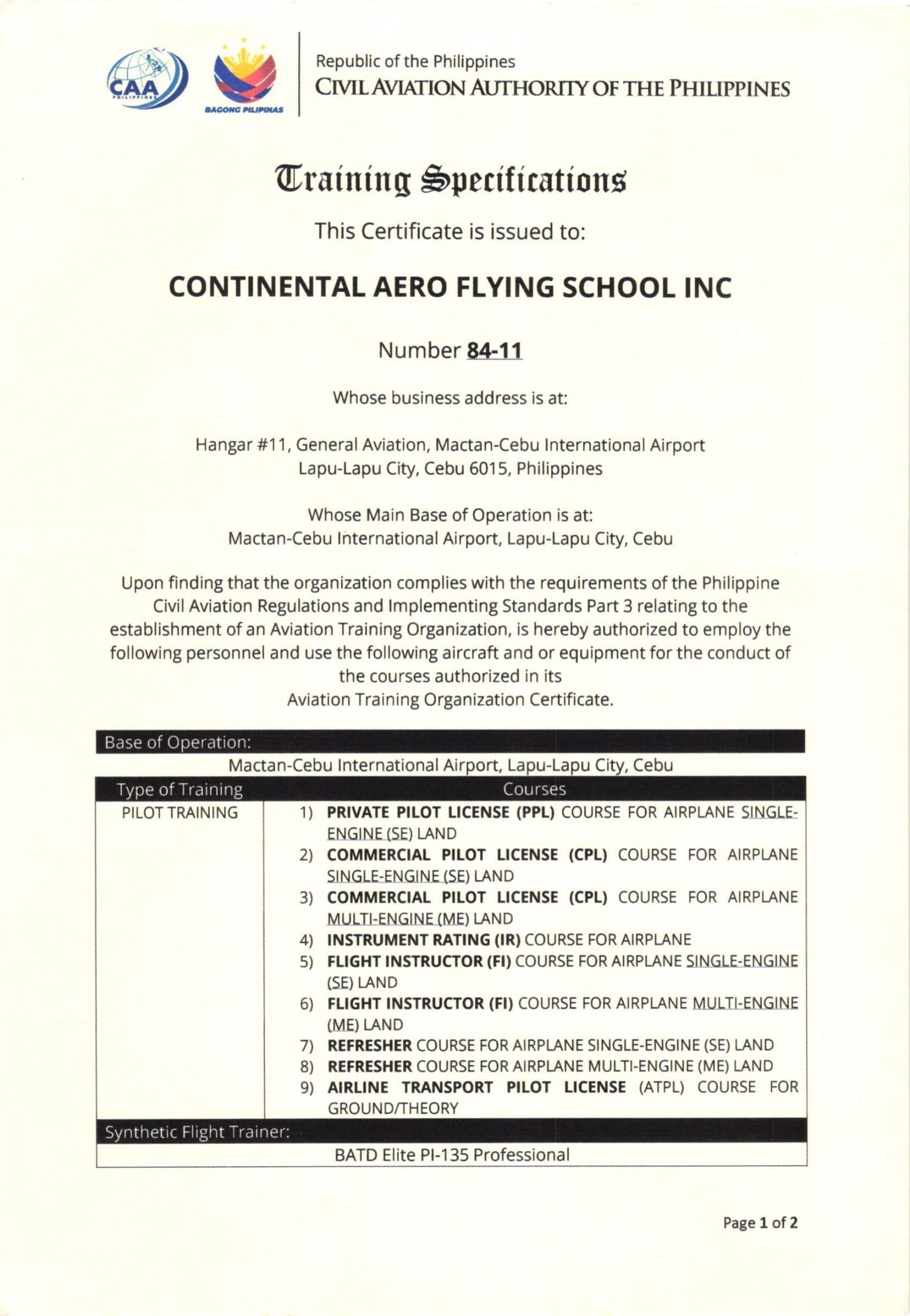
Published page of the CAFS Approved Training Organization Certificate. Full multi-page certificate retained on file with CAAP; verification available to airline partners and sovereign counterparts on request.
- 01 Private Pilot License (PPL) · Single-Engine Land
- 02 Commercial Pilot License (CPL) · Single-Engine Land
- 03 Commercial Pilot License (CPL) · Multi-Engine Land
- 04 Instrument Rating (IR) · Airplane
- 05 Flight Instructor (FI) · Single-Engine
- 06 Flight Instructor (FI) · Multi-Engine
- 07 Refresher · Single-Engine Land
- 08 Refresher · Multi-Engine Land
- 09 Airline Transport Pilot License (ATPL) · Ground/Theory
The three bodies
standing behind your license.
A CAFS-issued license recommendation isn't a private agreement — it's enforced by a chain of regulators extending from Pasay City to Montreal. Here are the three levels and what each guarantees.
The national regulator. Issues pilot licenses, inspects training organizations, investigates incidents, enforces Philippine Civil Aviation Regulations (PCAR). Every CAFS-trained pilot receives their license from CAAP — not from CAFS. CAFS recommends, CAAP approves.
UN specialized agency setting worldwide civil aviation standards. Philippines is a founding member (1944 Chicago Convention). ICAO Annex 1 (Personnel Licensing) defines the minimum standards every CAAP-issued pilot license must meet — so a Philippine license is globally recognized wherever ICAO applies.
The Philippine cabinet-level department under which CAAP sits. Sets aviation policy, approves major regulatory changes, and handles bilateral aviation agreements with other states (the mechanism by which Philippine licenses convert to FAA, EASA, and other foreign equivalents).
Your Philippine license
opens doors abroad.
A CAAP-issued pilot license is valid globally under ICAO, but to fly for a foreign-registered airline, most pilots also convert their license to FAA (United States) or EASA (Europe). Because Philippine training meets ICAO standards, the conversion pathway is shorter than starting fresh — usually just regulatory exams plus a check ride.
FAA Conversion Pathway
The FAA recognizes CAAP-issued licenses for pilots with at least 1,500 hours seeking an ATP. For lower-hour licenses (PPL, CPL, IR), conversion typically requires FAA written exams + FAA flight check by a Designated Pilot Examiner. No full retraining required — your Philippine training hours and experience are recognized.
EASA Conversion Pathway
EASA (now covering 31 European states) accepts CAAP-issued licenses for conversion under Part-FCL rules. Conversion involves theoretical exams (ATPL theory typically required for commercial conversion), a skill test, and language proficiency validation. The CAAP → EASA pathway is well-established and used by hundreds of Filipino pilots annually.
Conversion requirements change. Verify current pathways directly with FAA (faa.gov) or EASA (easa.europa.eu) before planning your international career path. CAFS advisors can provide general guidance, but regulatory authorities provide the binding answers.
One signed pipeline.
Forty-six years of alumni outcomes.
Most airlines recruit pilots through open-market hiring based on CAAP licenses and ICAO-recognized training — not through flight school MOUs. CAFS holds one formal direct pipeline (Skyway Airlines, cargo) and four decades of alumni hired across Asia and the Middle East through open recruitment.
Structured cadet-to-first-officer pathway with Skyway Airlines, a Philippines-based cargo carrier, for qualifying graduates (final selection subject to airline assessment). Under this formal MOU, Skyway Airlines assesses and hires CAFS CPL graduates on a preferential basis — the structured cadet-to-airline pathway built into the Cadet Pilot Program.
Airlines that employ CAFS alumni through open-market recruitment — based on their CAAP licenses plus ICAO-recognized training. These are employment outcomes, not partnership claims.
Milestones in the
paperwork.
Credentials accumulate over decades. Here's how CAFS's regulatory standing developed from 1980 forward.
Don't take our word
for any of it.
You can verify every claim on this page independently. That's the whole point. Below are three ways to confirm CAFS's regulatory standing without asking us.
The Vision and Mission statements filed under CAAP Air Training Organization Certificate No. 84-11. Recorded here as a matter of institutional record.
To be established as one of the top aviation organizations to provide training, knowledge and consulting services all around the globe for individuals and business societies with recognition by higher education and greater exposure.
To promote the value of learning, self-worth and quality performance among students and staff, and transition of students to productive and responsible participation in the society.
The story behind
the certificates.
Ready to train with a
verified school?
Your first flight at CAFS is a Discovery Flight — a one-hour introductory lesson where you handle the controls yourself, accompanied by a certified instructor under Approved Training Organization Certificate No. 84-11.