For an airline considering a cadet pipeline partnership, the most credible signal a flight school can offer is rarely the school's own brochure. It's an outsider — preferably one with credentials, scrutiny, and no commercial relationship — who chose to fly here, write about it honestly, and put their name on the result.
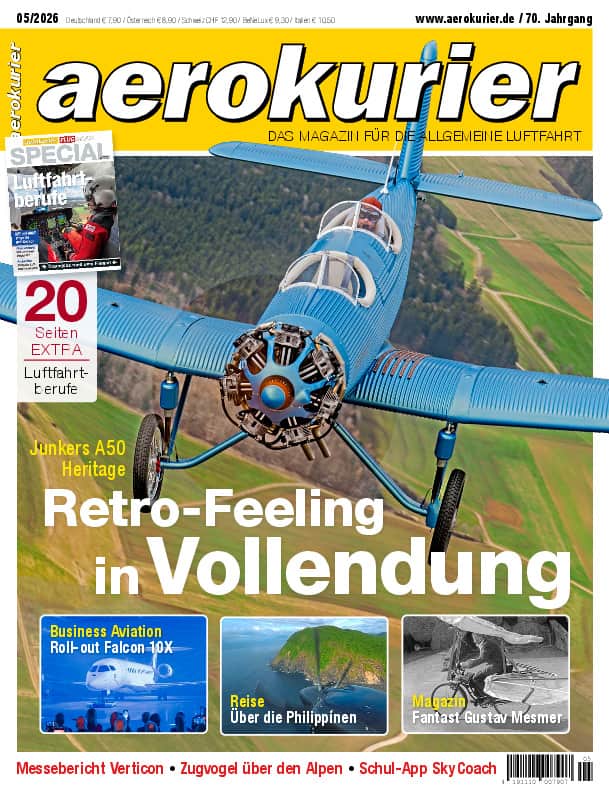
That's what arrived in May 2026 when aerokurier, Germany's longest-running general aviation magazine, dedicated 10 pages of its 5/2026 issue to a feature called "Insel-Hopping" — author and pilot Peter Schneider's account of training and flying across the Philippines from Cebu. The piece names Capt. Jithin J. Bhadran as his flight instructor, identifies the specific CAFS aircraft used, and walks through the CAAP foreign-license validation pathway in operational detail.
Who is aerokurier?
Founded in 1956, aerokurier is published monthly by Motor Presse Stuttgart — one of Europe's largest specialist publishers — and is widely regarded as the German-speaking world's flagship general aviation title. The magazine reaches private pilots, flight schools, aircraft owners, and aviation professionals across Germany, Austria, and Switzerland. Its 70th year of continuous publication makes it one of the longest-running aviation journals in the world.
Editorial standards are explicitly independent: features are written by named pilot-journalists who travel, fly, and pay their own way, then file. aerokurier doesn't run paid advertorials disguised as features, and the magazine's reputation for honest reporting is exactly what makes a positive 10-page treatment carry weight.
The author: Peter Schneider
Schneider is a regular aerokurier contributor — the magazine itself notes that he "repeatedly enriches the publication with pilot stories from around the world." At 74, with roughly 1,700 flight hours logged, he holds both EASA (the European pan-state aviation authority) and FAA (United States) pilot licenses. Before this trip he had never flown in the Philippines.
Two things matter about that profile for any reader assessing CAFS:
- License-portability expertise. A pilot who already holds EASA and FAA credentials is exactly the kind of foreign student a flight school's validation pathway is designed for. Schneider is the test case.
- 1,700 hours of comparative judgment. An ab initio student doesn't yet know what good instruction feels like. A 1,700-hour pilot does — and Schneider's verdict is the verdict that matters.
What CAFS provided
The article identifies — by tail number where applicable — the operational scope of Schneider's training and rental hours over a roughly 14-day stay:
- Cessna 172 — approximately 1 flight hour at the start of the trip
- Beechcraft Baron · RP-C3656 — approximately 7 hours of MEP (Multi-Engine Piston) training and validation flying
- Cessna 210 Centurion · RP-C3203 — rented from "Jithin's aircraft fleet" for the "Validation in Work" island-hopping legs
- CAAP foreign-license validation pathway — described in detail across page 75, including the operational sequence and required documentation
- John Bourdon Ground School in Cebu — the air-law theory test prep partner Schneider visited
Total cockpit time across the trip: 1,577 nautical miles. Average all-in cost (rental + landing fees + handling): ~850 EUR per hour — a number Schneider publishes in the article without commentary, which means the magazine's editorial side accepted it as fair.
die den Einmot-Piloten ans Baron-Steuer bringen.
Translation: "Validation in Work" — the magic words that put a single-engine pilot at the controls of a Baron.
What the headline quote means for international cadets
"Validation in Work" is the working classification CAAP issues to a foreign-licensed pilot during the conversion process. For Schneider — already an EASA and FAA pilot — it meant that within the validation window, he could legally fly a multi-engine aircraft (the Beechcraft Baron) across the Philippine archipelago under CAAP oversight, with a CAFS instructor as the named CFI.
This is the same pathway available to any qualified foreign-licensed pilot considering CAFS: validate the existing license, log MEP and IR hours on Philippine-registered equipment, and either return home with the additional ratings or proceed to full CAAP conversion. The fact that aerokurier walks through this process operationally — not as theory — is the strongest endorsement of the pathway's reliability.
The aircraft, by name
It's worth emphasizing: the magazine identifies the actual tail numbers. RP-C3656 is the Beechcraft Baron Schneider trained on for MEP. RP-C3203 is the Cessna 210 Centurion he rented for the island-hopping legs. Both are CAAP-registered, both are part of the operational fleet at Continental Aero Flying School, and both are documented in a peer-reviewed European publication for due-diligence purposes.
For an airline talent-acquisition team evaluating where their cadets will train, this kind of public, third-party identification of equipment removes an entire category of due-diligence questions before they're asked.
und 1.577 nautische Meilen im Cockpit.
Translation: "My personal conclusion: a good hour of Cessna 172, a good seven hours of MEP training on the Beechcraft Baron, and 1,577 nautical miles in the cockpit."
The relational angle
The article closes with a paragraph that sits outside operational reporting and crosses into something rare in trade press — a personal note about the instructor relationship that developed across two weeks of flying together:
vom Bekannten zum Freund geworden.
Translation: "Over time, Jithin has gone from acquaintance to friend."
For students choosing a flight school, the operational rigor of the institution matters first. But the long-haul reality of a pilot's training is that you're going to be in the right seat with one CFI for a lot of hours. The fact that a 1,700-hour pilot ends his account with this line is the closing argument the magazine left in.
Why we're flagging this
CAFS has been operating since 1980 — 46 years of CAAP-certified continuous operation under Air Training Organization Certificate 84-11. We have zero recorded training accidents across that period and have graduated cadets who now fly with Cebu Pacific, Philippine Airlines, AirAsia Philippines, FedEx, Korean Air, and Emirates. The infrastructure speaks for itself.
What it doesn't speak to is what flying here actually feels like — and that's where independent press matters. Peter Schneider didn't have to write nicely. aerokurier didn't have to dedicate 10 pages. They did, because the operation held up to a 74-year-old EASA/FAA pilot's standards.
For airlines evaluating cadet pipeline partnerships, for foreign students considering CAAP license validation, and for parents trying to figure out whether the Philippines is a credible training destination — this is the citation we point at first.